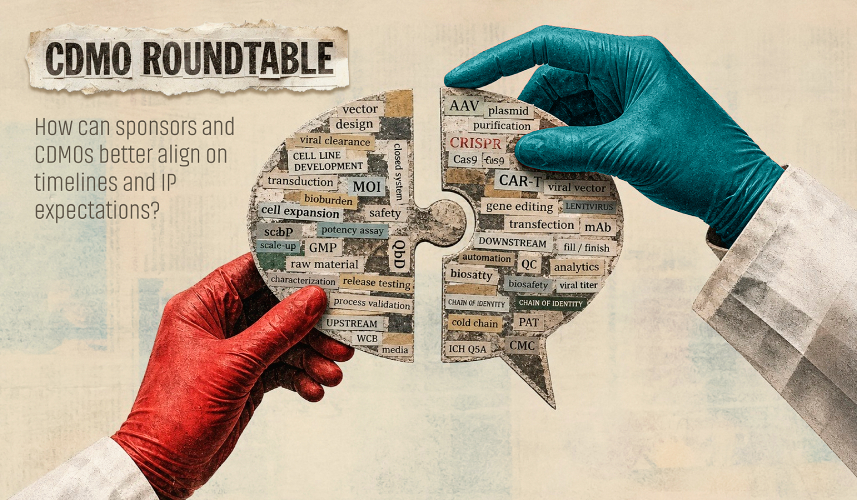
Some argue that CGT timelines are often driven more by aspiration than manufacturing reality. How can sponsors and CDMOs better align expectations?
Robert Guiser, director of innovation, Biologos:
Transparency is more important than optimism. Forecast changes, supply chain constraints, and technical challenges happen on almost every project. Raising them early gives both organizations the opportunity to adjust expectations and develop mitigation plans before schedules begin to slip.
Eytan Abraham, chief commercial and technology officer, Minaris Advanced Therapies:
Everyone wants to move quickly, especially in a field where patients are waiting for new treatment options. The challenge is that ambitious timelines don't always account for the realities of manufacturing, testing, regulatory requirements, and supply chain readiness.
The best way to stay aligned is to involve manufacturing and testing experts early. When sponsors and CDMOs have open discussions about process maturity, analytical readiness, raw materials, and potential risks from the beginning, it becomes much easier to build timelines that are both ambitious and achievable.
As programs advance, the conversation should extend beyond getting material into the clinic. More therapies are reaching late-stage development and commercialization, which means sponsors must think about scalability, process consistency, supply continuity, and regulatory expectations much earlier than in the past.
The strongest partnerships are the ones that regularly revisit assumptions, share data openly, and make decisions based on what the program needs rather than what the original timeline said six months earlier.
Stuart Curbishley, Ph.D., chief manufacturing and development officer, adthera bio:
The gap usually opens because investor-driven or clinical milestones are set before manufacturing reality is understood. Alignment starts with a shared, evidence-based timeline built jointly rather than a sponsor target imposed on a CDMO. Both should map CMC, regulatory and financing milestones onto one integrated plan and stress-test it against real process maturity, analytical readiness and stability-data generation. Comparability must be planned early and demonstrated on a variable, patient-derived scale, which takes time that unrealistic aspirational plans routinely omit. A strong project management team holding every partner to what they promised, on schedule, converts optimism into accountability. Transparency about failure helps too: quality issues are often discovered only at analytical readout, so timelines must build in that risk rather than assume first-time success. Sponsors should resist the cheapest, fastest path when it hides rework and relocation costs. Regular joint reviews, defined go/no-go gates, and honest capacity and lead-time data keep expectations grounded. The discipline is treating the timeline as a co-owned consequence of process engineering, not a fundraising slide.
Ahmed Yahia, director, business development, cell and gene technologies division, AGC Biologics:
Most timeline issues don't come from a lack of commitment — they come from optimism. Sponsors understandably want to move as quickly as possible, while manufacturing progresses at the pace allowed by the science and the data.
The best way to stay aligned is through transparency from both sides. As CDMOs, we have a responsibility to be honest about technical risks, critical assumptions and realistic timelines, even when those conversations are difficult. At the same time, sponsors should openly discuss their clinical objectives, funding constraints and key decision points.
Rather than building a plan around the best-case scenario, it's much more valuable to agree upfront on technical milestones, contingency plans and clear go/no-go decisions. That creates a partnership where everyone is working toward the same objective with realistic expectations.
Christian Cobaugh, Ph.D., CEO, genetic medicines division, Alloy Therapeutics:
Misalignment around expectations often starts with sponsors building timelines based on their funding story rather than on what manufacturing teams can actually deliver. This misalignment between business needs and manufacturing reality is especially true in the cell and gene therapy space, where every step carries more variability than people want to admit. Closing that gap requires deliberate work by both the innovator and the CDMO.
Innovators need to engage CDMOs early and take their time with the request for proposal. Also, innovators should use their board of directors to identify potential CDMO partners and pressure-test submitted proposals. If a proposal element doesn't make sense or the team cannot visualize how it will actually work, push for more detail, as vague answers at the proposal stage often become surprises during tech transfer.
The innovator and CDMO teams should connect at multiple levels, including operations, quality, finance, legal, and executive. Additionally, schedule a site visit, as the teams executing the project will reveal more about realistic timelines than any business development conversation. Above all, treat the program as a partnership rather than a transaction. The sponsors who get to the clinic close to their target dates are the ones who built enough trust with their CDMO to be honest about what is possible, allowing the relationship to work when reality intervenes.
Thomas Fellner, Ph.D., vice president, global head of commercial development, Lonza Specialized Modalities:
One recurring disconnect is that clinical milestones are often set first, and manufacturing activities are then worked backward into the schedule. The pressure to move quickly is understandable, particularly when the next clinical milestone may be closely tied to financing, but analytical development, comparability work and tech transfer cannot always be accelerated simply because the target date moves forward.
These activities require significant rigor and are often closely interconnected. A sponsor may plan a process change, scale-up and site transfer as separate milestones, but each step can create new analytical requirements and comparability considerations. As a result, an apparently achievable timeline can quickly come under pressure.
Rather than assuming every milestone will proceed exactly as planned, most sponsors build contingency into their development plans. The fastest programs are not necessarily those with the most aggressive timelines, but rather those in which sponsors and CDMOs are transparent about assumptions, dependencies and technical risks from the outset.
Larry Pitcher, CEO, Kincell Bio:
This gap is real, and I’ve seen it most often when a program's early timeline is established before manufacturing is even in the room. Too often, a development team gets a strong clinical signal and builds a plan around the fastest possible path to the clinic, without asking what the rapid pace will cost later.
The solution starts with sponsors bringing manufacturing into the conversation earlier than it may seem necessary. If a process decision made under research-phase pressure won't scale or won't hold up under GMP expectations, the sponsor needs to know before it is included in a regulatory filing.
For an experienced cell therapy CDMO, the obligation is to be honest about trade-offs rather than just executing the sponsor's direction. Sometimes speed is the right call given funding and competitive pressures, but sponsors should know the likely costs of that choice up front. There is nothing wrong with taking a phase-appropriate approach if it is intentional. Problems arise when technical debt accumulates without everyone understanding the downstream consequences.
Manuel Balbuena, CCO, eXmoor Pharma:
I would rather have the difficult timeline conversation at the start than discover halfway through tech transfer that the plan was never realistic. The cost of that discovery in time, money and investor confidence is consistently higher than the cost of the conversation that was avoided.
Getting to first-in-human quickly matters, especially in a capital-constrained market. The problem is when the manufacturing plan has not been stress-tested before the clinical timeline becomes fixed. Sometimes, a GMP slot gets booked, the transfer begins, and only then do the right questions arrive: Are analytical methods qualified? Are starting materials available at scale? What does a realistic batch release timeline look like once the qualified person (QP) has sight of everything?
Building timelines from the manufacturing route rather than back from a clinical aspiration requires both sides to be candid about where the uncertainties sit. CDMOs should be honest about what they do not yet know. Sponsors need to be willing to ask what is genuinely sufficient for a first-in-human study versus what needs proper resolution before later phases. Getting that distinction wrong in either direction creates avoidable cost, and it is almost always easier to resolve at the start than to unpick once a transfer is under way.
Maria Colombo, Ph.D., director, R&D, Thermo Fisher Scientific:
Early partnership helps ensure that development plans are grounded in manufacturing realities and that potential challenges are identified before they impact timelines.
A key aspect is designing processes, materials, and analytical strategies with future development stages in mind. This helps avoid situations where early R&D products or processes cannot be used in toxicology studies or later clinical phases, resulting in costly rework and delays.
Regular communication, transparent risk assessments, and realistic planning around manufacturing capabilities, technology transfer, regulatory requirements, and scale-up activities are also critical. By aligning development and manufacturing strategies early, sponsors and CDMOs can establish more achievable timelines, reduce redevelopment efforts, and accelerate progress toward clinical and commercial milestones.
Stuart Lowe, Ph.D., head of advanced therapies, TTP:
Alignment of expectations is about finding a common framework that sponsors and CDMOs alike can use to understand and agree on potential trade-offs so that surprises in development can be managed more effectively. For more established processes, a shorthand for these discussions often centers around the resources needed to achieve a specific COGS target. For less standardized processes, the approach to reducing COGS may be more nuanced and requires understanding of equipment capabilities at scale, operator hands-on time and facility occupancy. TTP has developed a framework that takes into account these parameters and identifies process bottlenecks before they happen, generating appropriate steps to take to mitigate — such as closing specific process steps, or adding remote monitoring to reduce contact time. Armed with this information, sponsors can then discuss manufacturing strategy and timelines that align with their commercial objectives, with any assumptions and compromises clearly understood.
How can sponsors and CDMOs better align on IP expectations to build stronger CGT outsourcing partnerships?
Eytan Abraham, chief commercial and technology officer, Minaris Advanced Therapies:
The most successful partnerships address intellectual property expectations before the work begins, not when a question comes up halfway through a project. Sponsors and CDMOs each bring something valuable to the table. Sponsors bring the therapeutic concept and product-specific expertise. CDMOs contribute manufacturing know-how, testing capabilities, quality systems, and platform technologies that have often been built over many years.
Problems usually arise when there are assumptions about ownership that were never discussed. Clear agreements around existing technologies, process improvements, analytical methods, and any new developments help avoid misunderstandings later. As therapies move toward commercialization, these discussions become even more important because the processes, methods, and systems established during development often become the foundation for long-term manufacturing and supply strategies.
When both sides are transparent from the start, IP becomes much less of a friction point. The conversation can stay focused on what matters most: advancing the therapy and getting it to patients as efficiently as possible.
Robert Guiser, director of innovation, Biologos:
Trust starts with clarity. Define intellectual property ownership early, establish clear agreements, and build relationships where technical discussions can happen openly without uncertainty over ownership.
Manuel Balbuena, CCO, eXmoor Pharma:
IP tends to get raised at the wrong point. It surfaces during contract negotiations, after both parties have invested time and started to align on technical approach. By then, what should have been a straightforward discussion can become much harder.
If a sponsor cannot move its process to another manufacturer later, or is unclear about what it owns relative to what the CDMO has contributed, that affects the sponsor's position in fundraising conversations, reduces optionality in partnering discussions and can constrain future manufacturing strategy in ways that are costly to resolve.
Clarity upfront matters on how background IP is handled, what happens to process improvements and manufacturing data, and whether platform constraints will limit the sponsor's ability to adapt or transfer the programme later.
Our view at eXmoor Pharma is that sponsors should retain control of their innovation. We do not retain client IP. A CDMO can bring genuine process and manufacturing expertise to a program without creating dependencies that outlast the engagement. CDMOs have a legitimate interest in protecting proprietary background expertise, but the default position should be the sponsor's freedom to operate, established at the start.
Maria Colombo, Ph.D., director, R&D, Thermo Fisher Scientific:
Key elements include:
- Ensuring that sponsors have a thorough understanding of the IP landscape surrounding their product, technology, and manufacturing process.
- Engaging proactively with relevant IP holders and licensors to clarify rights, obligations, and potential restrictions before they become development bottlenecks.
- Promptly identifying and addressing any patent considerations or freedom-to-operate concerns as they arise.
- Avoiding the common mistake of underestimating the time and complexity associated with licensing negotiations, which can significantly impact project timelines.
- Clearly defining ownership and usage rights for process improvements, manufacturing know-how, analytical methods, and other project-related innovations.
- Leveraging preferred partnerships and established licensing frameworks where appropriate to streamline discussions and reduce execution risks.
Jerry Williamson, CEO, Phosphorex:
Problems can most definitely arise if sponsors and their CDMOs don’t have upfront, thorough conversations about intellectual property ownership. Phosphorex is a fee-for-service CDMO, meaning the IP for a therapeutic belongs to our innovator clients. We don't take an equity stake in outcomes, and we don't retain rights to what we develop on a client's behalf. Critically, we maintain ethical firewalls between programs to ensure each client’s proprietary IP is fully protected.
Interestingly, as a drug-delivery CDMO, we often help our clients extend their molecules’ patent protection. A new drug delivery strategy can reset the patent clock, creating new value for their product portfolio and for patients by delivering therapeutic molecules more precisely, or perhaps in ways that sharply reduce immunogenicity or other side effects.
Subscribe to our e-Newsletters
Stay up to date with news, articles and insights relevant to cell and gene therapy development and manufacturing. Plus, get special offers from Cell & Gene Therapy Review delivered right to your inbox!
Sign up now!