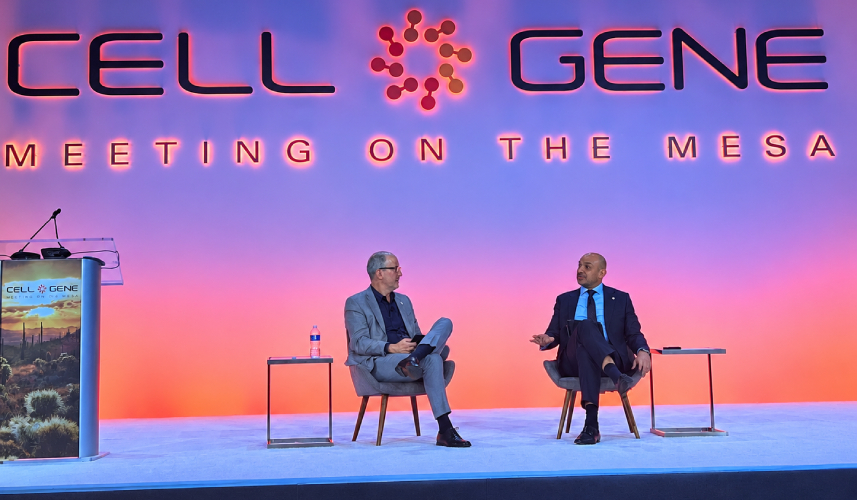
During the keynote at ARM’s Meeting on the Mesa, Karim Mikhail, recently selected to lead CBER after serving as the center’s acting director, offered a candid look at the challenges regulators face in accelerating the development of innovative cell and gene therapies for rare diseases.
That responsibility, he emphasized, ultimately rests with FDA. “If we don’t do it, no other agency will do it,” Mikhail said. “Protecting patients is a heavy burden on our shoulders.”
Flexibility requires judgment
One recurring theme was regulatory flexibility and how difficult it can be to apply in practice. Mikhail said flexibility can feel like "getting off the highway and driving on the shoulder, and you're going to hit a concrete wall." In other words, an exception to the standard pathway can feel less like relief and more like a risky detour, particularly for CMC.
Currently, he noted, flexibilities are generally applied consistently across CBER. But he questioned whether that should always be the case: “Right now the flexibilities are the same across CBER; but should we think about ultra-rare?”
Much of the answer, he suggested, comes down to "regulatory judgment." Even with deep expertise, regulations, guidance and precedent, difficult development and approval decisions rarely have a purely mechanical answer. In months of reviewing regulatory files, Mikhail said, only one generated essentially no substantive debate. Most require an experienced regulator who can say, "I have all the facts; I can integrate all of them." That means weighing precedent and requirements and also asking whether an intervention offers patients something meaningful.
“You’re looking at precedent; you’re looking at 21 CFR whatever,” he said. “But at the same time, using also my heart — which is not always used — to ask, if a patient needs something, does this option deliver something beyond a claim? Is there a true benefit? There needs to be a clear benefit."
"That's why this is a challenging job," he says.
Learning from other regulatory systems
Mikhail also discussed FDA’s efforts to learn from regulatory approaches outside the United States. “We spent quality time trying to understand what the Chinese did, what the Australians did, and how can we apply this in a real American way.”
FDA will not simply replicate those systems, said Mikhail. “We will never have a China-like system, and we will never have an Australian-like system because we believe there are gaps in both of them. But we can learn and take the best from all.”
Expectations for early clinical development have evolved, Mikhail said, including what sponsors should provide in an initial IND. “A couple of months ago, we came out with an announcement saying the requirements for phase 1 IND had evolved and changed,” he said, with a particularly simple message for sponsors: “Don't submit more than that because it doesn't help you.”
More engagement before the IND
CBER has also recognized that more effort may be needed before an IND is submitted.
The current pre-IND model can be limiting. Sponsors generally have a single formal pre-IND meeting, forcing them to prioritize questions across CMC, pharmacology/toxicology, and clinical development. Those disciplines do not necessarily mature on the same timeline. A meeting may already be late for a critical pharmacology/toxicology question while simultaneously being too early for the most useful CMC discussion.
The process itself also introduces practical limitations. FDA needs time to review a meeting package, the interaction is relatively brief, and the resulting advice is nonbinding. For small and mid-sized biotechnology companies in particular, this can leave important development decisions without sufficient regulatory-science support at the time they need it most.
One potential solution Mikhail described is the creation of “qualified research institutes” (QRIs) — organizations with regulatory science, pharmacology/toxicology, clinical, and other development expertise that could help smaller companies advance programs toward IND submission.
Under a proposed pilot concept, FDA is willing to open what Mikhail described as a “rolling pre-IND” process when a sponsor is working with a QRI. Rather than concentrating regulatory interaction into a single meeting, the model could allow development questions to be addressed as they arise.
The concept could potentially extend to clinical protocol development as well. A QRI could review a draft clinical trial protocol, and the approach could allow earlier interaction with an IRB rather than waiting until after IND allowance to begin portions of that process.
Rebuilding expertise inside CBER
Mikhail also spoke candidly about workforce challenges at the agency.
“We’ve lost many good people,” he said, describing recent “regretted departures.” The priority now, he said, is to “stop or slow down the attrition.”
One important vacancy that needs to be filled is the director of CBER’s Office of Therapeutic Products (OTP), which oversees the FDA’s regulation of cell and gene therapies. Vijay Kumar stepped down from the role in June 2026. Mikhail is currently overseeing OTP on an acting basis while the FDA searches for a permanent director.
By Mikhail’s count, OTP is roughly the third-largest organization at the agency to manage by headcount. With several management layers, people-management skills are unavoidable. The director has to empower staff, and also be able to ask, "Have you thought about this differently?" instead of flatly telling someone "That's not a good idea," because nobody responds well to that.
Flexibility without shortcuts
Mikhail's comments suggest a CBER that is actively reconsidering how it applies flexibility and when it engages with sponsors, while acknowledging the central role regulatory judgment already plays, particularly for products aimed at patients with few or no existing options.
The goal is faster development, and Mikhail was candid that U.S. competitiveness is part of what drives it. But he was equally clear that speed cannot come at the expense of rigor. The challenge is determining where flexibility can meaningfully accelerate development without abandoning the responsibility he returned to throughout his remarks: protecting patients while determining whether a new therapy offers a "true benefit."
Subscribe to our e-Newsletters
Stay up to date with news, articles and insights relevant to cell and gene therapy development and manufacturing. Plus, get special offers from Cell & Gene Therapy Review delivered right to your inbox!
Sign up now!