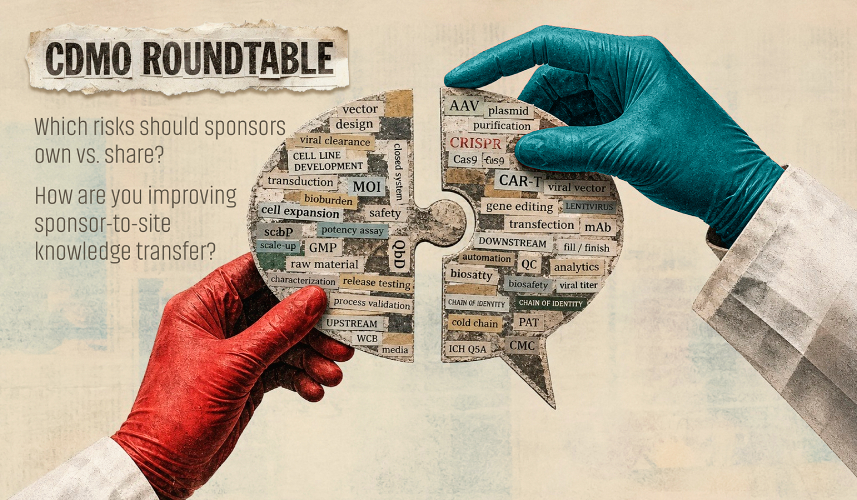
Which risks in CGT development are best owned by sponsors, and which are better managed collaboratively with CDMOs?
Larry Pitcher, CEO, Kincell Bio:
Sponsors should own the risks associated with their science, including factors like target selection, mechanism of action, the fundamental biology underlying therapeutic efficacy, and clinical trial design. Where programs should become more collaborative is in the development work after proof of concept. For instance, process development, scale-up, and analytical method development are areas where a CDMO with deep cell therapy experience should help navigate decision making, not just execute sponsor-developed processes. Unfortunately, I've seen sponsors lock in a process with a generalist partner and then struggle to scale it later because problems weren't identified and addressed early, when it would have been much less time-consuming and expensive to fix.
Regulatory risk falls somewhere in between. The sponsor owns the strategy and the relationship with regulatory agencies, but a CDMO experienced in cell therapy IND- and BLA-enabling work can identify CMC gaps early and help avoid costly regulatory delays. Supply chain and timeline risks need to be shared. If a raw material lead time changes or a batch fails release, there needs to be very clear and open communication that allows the CDMO and sponsor to work together to fix the problem.
Robert Guiser, director of innovation, biologos:
Own the decisions only you can make. Sponsors should define the product requirements, specifications, testing strategy, regulatory expectations, and commercial forecasts. The CDMO should own manufacturing execution and supply chain management while communicating operational risks early so both sides have time to respond.
Manuel Balbuena, CCO, eXmoor Pharma:
The sponsor should own the therapy. The CDMO should help make sure it can be manufactured, released and supplied in a way that matches the clinical plan.
Strategic ownership sits with the sponsor: the clinical thesis, therapeutic intent, core IP, investment priorities and final decision-making. A CDMO that starts shaping those things is overstepping.
Where collaboration matters is on the operational side. That includes decisions like whether the process will transfer successfully, whether analytical methods are fit for a GMP environment, and whether batch release timelines are realistic once QA review is properly accounted for. These questions require both parties working from a clear picture of where things stand. When that picture differs, the gap tends not to surface until the programme is already affected.
Part of a CDMO's job is to push back constructively. If a process decision made early is likely to create a comparability problem or a scale-up difficulty later, raising it while there is still time to act is part of the value.
Maria Colombo, Ph.D., director, R&D, Thermo Fisher Scientific:
Sponsors should primarily own risks related to the product itself, including:
- Potency assessment, as it is directly linked to the product's mechanism of action and expected efficacy.
- Toxicology studies and safety evaluation, including the assessment of potential side effects using relevant cell-based assays.
These activities should nevertheless be discussed closely with the CDMO to ensure they are compatible with the manufacturing and analytical strategy.
Risks related to process development, manufacturing, scale-up, technology transfer, and GMP compliance are best managed collaboratively between the sponsor and the CDMO. Ultimately, success depends on clear responsibilities and close collaboration throughout development.
What best practices is your company implementing to improve knowledge transfer between sponsor development teams and your manufacturing sites?
Robert Guiser, director of innovation, Biologos:
Knowledge transfer is a conversation, not a document.Documentation is essential, but the most valuable knowledge is exchanged through technical discussions that uncover assumptions, clarify expectations, and identify risks before manufacturing begins.
Stuart Curbishley, Ph.D., chief manufacturing and development officer, adthera bio:
adthera’s approach treats knowledge transfer as a structured discipline, not a document hand-off. The foundation is a single source of truth for process, analytics and critical factors, so development intent is captured unambiguously and carried into manufacturing.
adthera harmonizes processes and SOPs across sites and controls or eliminates within-unit-operation variability, so transferred knowledge sits on a consistent operational platform. Centralized technical ownership sits across the network: it detects product drift early and shares learnings, so a second site avoids the first site's mistakes. Adthera also embeds sponsor development scientists alongside our manufacturing teams during transfer, using electronic run records and shared data infrastructure to make process logic and rationale — not just parameters — visible to both sides.
Comparability packages are co-developed from the outset rather than reconstructed later, recognizing that patient material is variable and comparability must be demonstrated and defended accordingly. It’s also important that CDMOs distinguish negotiable from non-negotiable changes explicitly, so no transfer step inadvertently alters product characteristics. A dedicated project manager governs the transfer, holding every function to agreed deliverables and timelines. The aim is the same product everywhere, with development knowledge preserved end to end.
Qingzhou Ji, Ph.D., vice president, Porton Advanced:
In CGT, knowledge transfer most often fails on tacit know-how rather than documentation. To close the gap between sponsor development teams and our manufacturing sites, as a CGT CDMO company, we are implementing these best practices:
- Appoint a single Tech Transfer owner accountable for coordinating both sponsor and internal site teams, avoiding fragmented communication and lost details;
- Engage early with the sponsor's R&D team before process lock to capture critical process parameters, and provide in-time feedback on which parameters prove impractical during hands-on scale-up;
- Require to execute the process on sponsor’s actual equipment, followed by a reverse shadow at our manufacturing site to confirm parity, with senior sponsor experts providing on-site training—including lessons from failures and constraints discovered during development.
- Ship identical reference materials to both labs and run parallel potency and identity assays before transfer to calibrate inter-site variability.
- Conduct a risk-based gap FMEA across equipment, raw material lots, and scale, and develop a pre-approved mitigation playbook for each identified risk.
- Complement text SOPs with annotated videos of critical manual steps and troubleshooting guides to preserve unwritten expertise.
Katie Jorgensen, VP, site head, ElevateBio BaseCamp Waltham:
What best practices are your company implementing to improve knowledge transfer between sponsor development teams and your manufacturing sites?
The strongest knowledge transfers begin by recognizing that the sponsor holds subtleties no protocol fully captures. They've created and lived with the process. Our job is to draw that experience out early, through demonstration runs at our site or observation runs at theirs, with our manufacturing operators in the room alongside our scientists. The people who will execute the process need to understand its variabilities firsthand, before those variabilities become a disposition problem.
From there it becomes an operational discipline. Our MSAT team owns transfer batch success, and we document everything in our knowledge management system so what one team learns carries forward to every program that follows. We tie that knowledge into slot planning and materials lead times, so a process isn't just understood; it's scheduled, resourced, and ready for its first GMP run.
We also keep sponsors integrated from day one. As soon as we kickoff a program, we schedule intensive workshops to get SMEs from both teams in one room and deep-dive each element of the process. This is where we differentiate ourselves: leveraging people knowledge, not just paper knowledge. From the onset, we establish communication directly between SMEs, without over-governing the natural flow of information.
Subscribe to our e-Newsletters
Stay up to date with news, articles and insights relevant to cell and gene therapy development and manufacturing. Plus, get special offers from Cell & Gene Therapy Review delivered right to your inbox!
Sign up now!