In the summer of 2008, I paid $24 to sit on a soggy lawn and watch an up-and-coming country artist open for Brad Paisley at the PNC Bank Arts Center in Holmdel, New Jersey. She was 18 years old, had released just one album, and at one point walked onstage wearing an inflatable tick costume — a joke referencing one of Paisley’s songs.
Five months later, that same artist released her second album, crossed over from country into pop, and launched her transformation into the global superstar we now know as Taylor Swift.
Hold your eye roll — I promise I won’t subject you to an entire column about T-Swift. But let’s talk about the myth of the overnight sensation. The phrase is often used to describe an artist who suddenly becomes wildly successful after being relatively unknown. Yet in reality, success rarely happens overnight. Most musicians spend years writing songs, refining their sound, and building an audience before a breakout hit launches them into the spotlight. What looks like sudden fame is usually the result of years of work, experimentation, and failure happening behind the scenes.
When COVID hit, mRNA took center stage. But the industry knows that mRNA spent years in the studio, unreleased, before finally reaching a global audience. Its pandemic-era success was not a sudden breakthrough — it was the culmination of decades of research, engineering, and delivery advances finally converging at the right moment.
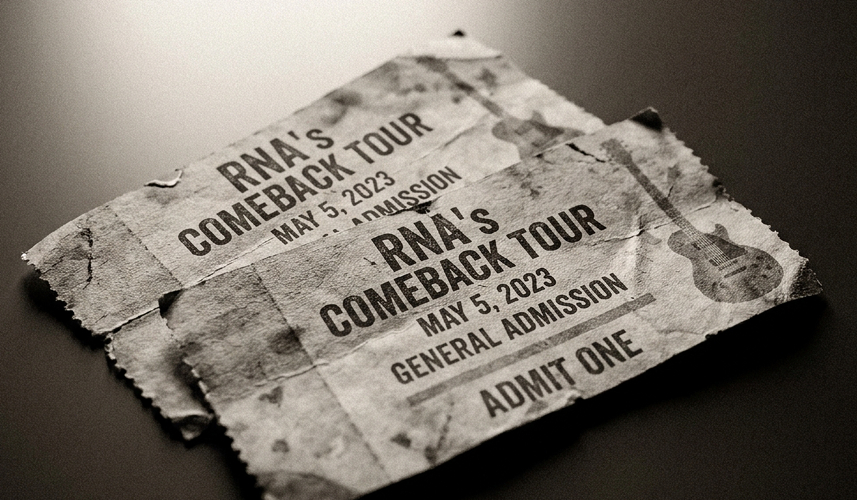
The unfortunate thing about moments is that they are, by definition, short-lived. Interest in the pandemic — and its vaccines — waned, and in the U.S., politics and vaccine skepticism further complicated the narrative. Some questioned if mRNA vaccines were RNA’s one-hit wonder.
The music industry is built around the idea that attention is temporary, and artists must continually create new hits to stay relevant. Great artists don’t disappear when they leave the charts. They return to the studio to experiment with new songs, sounds and genres.
Fortunately, RNA has the advantage of being an extremely versatile artist. It can play frontman, becoming the drug’s payload itself, as with Circio’s circular RNA platform, which creates a more stable RNA molecule designed to extend activity from hours to months. It can play backup, as in approved CAR-T therapies, where RNA serves as the messenger carrying instructions from permanently integrated DNA. It can manage the band, guiding an editing enzyme to the right genomic location, as in CRISPR/Cas9 gene therapy. And it can even rewrite the lyrics after the song has been written, as with Ascidian’s approach, which edits RNA transcripts directly without altering the underlying DNA.
As the next generation of RNA therapeutics takes the CGT stage, the technology is moving beyond its COVID-era breakout role. It could enable new approaches to in vivo CAR-T, address diseases beyond the reach of conventional gene replacement and editing technologies, and expand the therapeutic possibilities of genetic medicine.
The world may remember RNA for its breakout hit. But like any great artist, RNA’s legacy will be defined not by a single song — but by the catalog of possibilities it continues to build.
Subscribe to our e-Newsletters
Stay up to date with news, articles and insights relevant to cell and gene therapy development and manufacturing. Plus, get special offers from Cell & Gene Therapy Review delivered right to your inbox!
Sign up now!