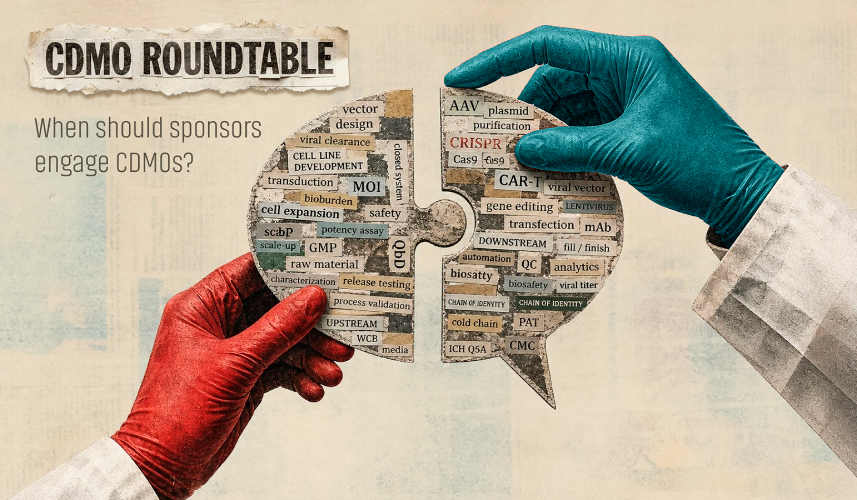
At what stage should sponsors begin engaging CDMOs?
Stuart Curbishley, Ph.D., chief manufacturing and development officer, adthera bio:
Far earlier than most teams do — ideally at the asset's conceptual stage, in parallel with the first regulatory conversations, not after a process has been locked. In cell and gene therapy the manufacturing platform shapes the process and target product profile, so engaging a CDMO with a fixed process often leads to expensive rework. Early dialogue lets both parties align chemistry, manufacturing and controls (CMC), regulatory strategy and financing on a single timeline — areas the cell and gene therapy sector consistently flags as the top challenge.
Practically, sponsors should run a fitness assessment before signing: does the CDMO have the analytics, the closed/automated platform suitability, and the capacity to carry the product beyond phase 1? A partner built only for phase 1 to meet early milestones only forces relocation and a process-development restart later. First-time sponsors in particular benefit from bringing in a consultant to vet CDMO fitness up front — money well spent at the beginning.
Engaging early also lets sponsors design comparability and tech-transfer packages from the outset rather than retrofitting them. The goal is a partner selected on strategic fit and scalability, chosen while the process is still flexible enough to co-optimize.
Ahmed Yahia, director, business development, cell and gene technologies division, AGC Biologics:
Naturally, the earlier sponsors engage a CDMO, the better. Discussions should start during late discovery or the preclinical stage, long before IND-enabling activities. Early engagement enables better development decisions while there is still room to adapt. Choices around process design, analytics, raw materials or scalability may seem purely technical at first, but they can have a major impact on timelines, costs and regulatory strategy later on.
When manufacturing experts are involved early, potential issues are identified before they become expensive problems. It also allows everyone to think ahead about technology transfer, facility fit and supply chain readiness. The programs that tend to move most smoothly are those where CMC and manufacturing are part of the conversation from the very beginning, rather than being considered once the process is already established.
Christian Cobaugh, Ph.D., CEO, genetic medicines division, Alloy Therapeutics:
Sponsors should engage CDMOs early, well before they actually need GMP material, so both parties can collaboratively align on a consistent quality strategy from the start. Even if a CDMO to manufacture material is not needed until the GLP-tox study, the transition from discovery to development is far smoother when both teams share a common understanding of the quality plans (e.g., attributes, methods, acceptance criteria) required at each phase.
Without this alignment, sponsors risk the painful scenario of having to rerun proof-of-concept studies with the CDMO's material once their development candidate is in hand, because the analytical methods, impurity profiles, or specifications won't translate cleanly. That rework delays IND-enabling studies and ultimately postpones reaching the clinic. Early engagement isn't about locking in manufacturing capacity sooner; it's about building a shared technical understanding, so the handoff is seamless when it does happen.
Robert Guiser, director of innovation, Biologos:
Start early enough to eliminate surprises. Every project is different, but the more complex the product, manufacturing process, or supply chain, the earlier a CDMO should be involved to identify risks before they become expensive problems.
Qingzhou Ji, Ph.D., vice president, Porton Advanced:
The optimal timing is during the discovery or preclinical phase, before the lead candidate's vector construct or cell line is finalized.
Engaging a CDMO at this early stage — around 12–24 months before an IND filing — enables it to serve as a true partner, providing inputs on manufacturability, developing potency and stability assays in parallel with the final commercial process, and producing GLP toxicology material using a clinically representative process. This proactive approach helps avoid costly comparability studies later. By contrast, waiting until phase 1 often forces major CMC rework, as late-stage process changes can trigger lengthy and expensive comparability exercises.
Sponsors should therefore engage CDMOs before locking in molecular design, not after generating research-scale data.
Thomas Fellner, Ph.D., vice president, global head of commercial development, Lonza Specialized Modalities:
Early engagement with a CDMO is critical, especially when seeking to accelerate the path to market for highly complex therapies. Sponsors should collaborate with CDMOs on strategy during early preclinical development, rather than waiting until after IND-enabling studies have been completed.
This is particularly important where early process choices can have long-term consequences. Decisions around scale, raw materials or manufacturing technology may appear manageable in preclinical development, but they can become much harder to change once clinical data has been generated.
This forward-thinking engagement also reflects changing external pressures. In a more selective funding environment, investors are asking harder questions about capital efficiency and a credible path to commercialization. At the same time, regulators scrutinize process understanding, comparability and control strategies as programs mature. For example, moving to a new manufacturing site, increasing scale or changing a critical raw material can raise comparability questions that are far easier to anticipate when manufacturing strategy is considered early.
By working with CDMOs early in development, sponsors can map out manufacturing processes that address both of these pressures and accelerate the path to market, even for the most complex therapies.
Larry Pitcher, CEO, Kincell Bio:
The earlier, the better. The mistake I see most often is sponsors treating CDMO selection as a manufacturing decision rather than a development decision. By the time a program reaches late preclinical or early clinical stages, many process choices have already been locked in, sometimes by a team with limited visibility into how the process would need to scale or how it would hold up under regulatory scrutiny as the program advances.
Changing course later in development costs a lot of time and money due to required comparability studies and other delays. For cell therapies specifically, early engagement matters even more. Autologous programs run on patient-specific timelines, with release testing constraints that must be designed at the beginning of the program. Allogeneic programs need a process built with comparability and lot consistency in mind from the outset.
I advise sponsors to begin engaging with potential CDMO partners as early as proof of concept and to establish a true development partnership well before IND-enabling activities begin. A partner with deep experience in your modality can help shape process decisions that improve scalability, manufacturability, and long-term regulatory success.
Manuel Balbuena, CCO, eXmoor Pharma:
Key manufacturing decisions are often made early, without being labelled as such. Process design choices, raw material selections, and analytical approaches carry consequences that become visible later and costly to address once the program has been built around them. In many cases, the sponsor already has a plan when a CDMO gets brought in and the possibilities are narrowed to how much can still be changed. Quite often, the answer is less than people expected.
The reason is understandable. Sponsors are working under real pressure from investors and grant milestones, and the CMC workstream often feels like it belongs to a later stage. The difficulty is that this front-loads the risk of avoidable rework, which is one of the more consistently damaging things that can happen to a development timeline and budget.
Early CDMO engagement does not mean outsourcing decision-making. It means using manufacturing knowledge to stress-test development decisions before they become fixed. For academic programs and early spinouts, where internal CMC expertise is often limited, that input can materially change the development route.
Maria Colombo, Ph.D., director, R&D, Thermo Fisher Scientific:
Sponsors should engage CDMOs as early as possible in the development process, ideally during the early development stages rather than waiting until clinical manufacturing is required.
Early engagement helps avoid costly and time-consuming redevelopment efforts when transitioning to GMP-ready production. It enables the selection of appropriate raw materials, manufacturing processes, analytical methods, and release strategies that are aligned with the product's development phase and long-term commercialization goals.
By involving a CDMO early, sponsors can benefit from expert guidance on process design, scalability, regulatory expectations, and manufacturing readiness, ultimately reducing development risks, accelerating timelines, and facilitating a smoother path to clinical and commercial production.
Stuart Lowe, Ph.D., head of advanced therapies, TTP:
TTP works with developers of next-generation advanced therapies whose process scaling needs are not well served by off-the-shelf manufacturing equipment, because of unacceptable compromises on labor intensity, facility costs, and process deviations. These currently are about 10-15% but growing quickly in number as next-gen therapies become more advanced.
Because these therapies are tackling areas that CAR-Ts can’t reach, such as solid tumors, the traditional model of transferring processes from sponsor process-development teams to standardized CDMO platforms isn’t working effectively. These developers need to incorporate a concurrent engineering step. Before approaching CDMOs, these next-generation developers are working with specialist providers like TTP to create purpose-built closed consumables and automated unit operations on which process scalability can be established before engaging with internal manufacturing teams or CDMOs for supply of clinical or commercial product.
Jerry Williamson, CEO, Phosphorex:
Too many sponsors wait too long. Frequently, they come to us after they've already locked in a formulation approach, sometimes after a failed batch or working with a CDMO partner that couldn't achieve their target product profile.
Phosphorex works with innovators to achieve their therapeutic objectives by leveraging innovative drug-delivery platforms, including lipid nanoparticles (LNPs), polymeric nanoparticles (PNPs), and polymeric microspheres. Since drug delivery is fundamental to a therapeutic’s success, the best time to engage a CDMO is during proof-of-concept and early formulation development phases. In a program’s early days, we help sponsors think through carrier selection, process scalability, and analytical strategy comprehensively, rather than addressing each area in isolation. The reality is that much of the program rework we see traces back to decisions made without this input, and those decisions were based on a particle size or polydispersity index (PDI) target that worked at the bench but couldn't effectively scale.
Sponsors don't need an established program to start the conversation. Some of our longest-running partnerships began with a single exploratory study, sometimes just a feasibility screening to determine whether a cargo-and-carrier combination was viable.
Subscribe to our e-Newsletters
Stay up to date with news, articles and insights relevant to cell and gene therapy development and manufacturing. Plus, get special offers from Cell & Gene Therapy Review delivered right to your inbox!
Sign up now!