The first time I walked into a clean room and saw a team coax fragile tissues toward clinical grade readiness, I was struck by a truth that doesn’t make headlines: Great science is only as useful as the materials that make it real. The promise of regenerative medicine — healing damaged tissues, restoring lost function, even replacing failing organs — depends not just on discovery but on having dependable, clinical-grade building blocks.
For many of the field’s most promising cell and gene therapies, that building block is human collagen and the wider extracellular matrix (ECM). Human collagen and the ECM are far more than passive scaffolds. They carry precise post translational modifications, cross links, embedded growth factors, and a complex mix of proteins that determine mechanical strength, degradation rate and biological signaling. Those molecular details govern how cells attach, migrate, differentiate and avoid immune rejection — in other words, whether an implant integrates and heals or triggers inflammation and failure.1
When clinicians use materials that closely mirror human biology, outcomes are more predictable; when inputs lack native structure or cues, performance, safety and translational timelines suffer. Yet despite their importance, clinical-grade human ECM supplies are scarce, and that shortage is a quiet brake on progress across the field.
The supply bottleneck
Human tissues suitable for making clinical-grade ECM are painfully hard to come by. Most sources are rare, ethically complicated, or already needed for other medical uses, so researchers often rely on one-off donations rather than a steady supply. Add strict donor screening, traceability rules, and regulatory paperwork, and the usable pool shrinks further. Many labs also lack the validated, scalable processes needed to turn tissue into consistent, GMP grade material. The upshot is an unreliable supply chain that drives up costs, slows clinical trials, and keeps promising regenerative therapies from reaching patients.2
Recombinant collagen and synthetic substitutes attempt to fill the gap, but they have meaningful limitations. Recombinant approaches generally use nonhuman host cells (CHO, yeast, bacteria) that cannot fully reproduce native human collagen’s post translational modifications and precise folding.3 Those differences matter: Folding, cross linking, and associated ECM proteins influence biocompatibility, mechanical behavior, and how tissues accept implants. Making recombinant material at scale is also expensive, which drives up price per gram and limits real world use. Synthetic scaffolds can copy the shape, but they often miss the full set of biological signals that tell cells how to behave.
In short, these alternatives can help, but they don’t fully replace the advantages of human-derived ECM, and scaling them to clinical volumes is still a major technical and economic hurdle.
Placenta as a practical solution
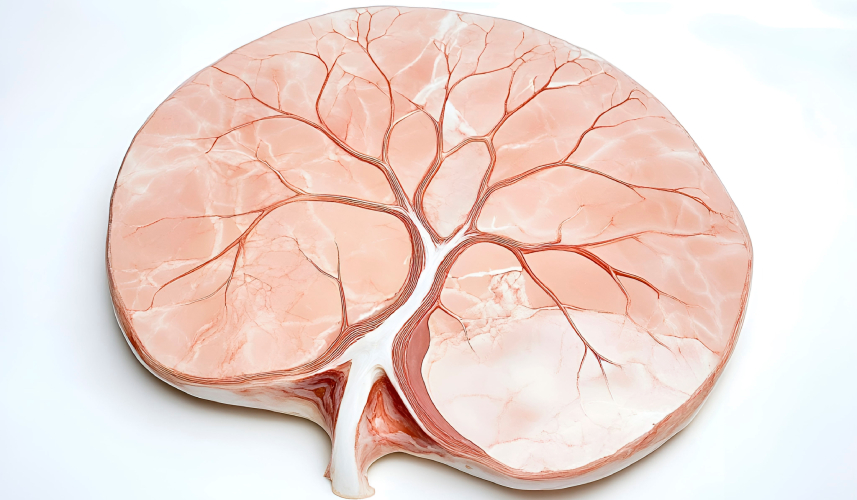
A practical, underused solution is the human placenta. Routinely discarded after healthy, full-term births, the placenta is abundant medical waste — an ethically straightforward, human-derived organ that’s rich in ECM proteins, collagen types and growth factors. Because placentas are nonessential after delivery, they don’t compete with other clinical needs.4 Placentas can be collected reliably through hospitals and birthing centers, and existing workflows for consent, transport and cold chain handling can be adapted to include placental collection without major new infrastructure.
Beyond being plentiful, placenta-derived ECM offers real biological advantages: Tissue-sourced collagen keeps the native chemical tweaks and triple helix folding that nonhuman recombinant systems often can’t reproduce.5 Those authentic molecular features matter for how the material performs in the body. Keeping the ECM in its native, human form preserves a mix of proteins, growth factors, and biochemical cues that tell cells how to stick, move and become the right tissue — the very signals needed for real repair and lasting integration. Because the material is human, it’s easier to translate into the clinic. Preclinical studies and regulatory conversations are more straightforward, and clinicians are more likely to trust and adopt it.
From concept to GMP reality
Collecting placentas is only the first step — scaling their use means putting rigorous systems in place. That starts with careful donor screening and validated handling protocols, plus early engagement with regulators. You also need GMP grade isolation methods that preserve the tissue’s structure and bioactivity: clear viability windows, tight transport rules, and processing steps that protect collagen and ECM from delivery room to clean room. Above all, the manufacturing setup must be built around quality control — reliable assays, validated release criteria, and full traceability from donor to finished product.6
When these elements align, the benefits are tangible. High recovery isolation processes can maximize ECM yield per organ and lower cost per gram relative to small scale recombinant production. Careful donor selection and controlled processing reduce batch to batch variability — a primary concern for clinicians and regulators.
Using native human ECM also reduces immunogenic risk and improves biocompatibility. For investors and partners, three practical KPIs matter: percent yield, QC assay reproducibility, and tech transfer timelines to engineering and released batches. Strong performance on these metrics converts placental ECM from an artisanal input into a predictable commercial feedstock.
Early clinical and commercial use cases
In the context of cell and gene therapies, human-derived extracellular ECM serves as a biologically active microenvironment that enhances therapies by supporting therapeutic cell survival, localization and functional integration.
Beyond providing structural support, ECM delivers biochemical and mechanical cues that regulate cell signaling, differentiation and immune interactions. By recreating aspects of native tissue architecture and acting as a reservoir for growth factors, human-derived ECM improves engraftment efficiency, promotes regenerative immune responses, and enables transplanted or genetically modified cells to function more effectively and durably in vivo.
Beyond these advanced therapies, near-term uses are practical and tangible: better wound dressings, coatings for implants and joint scaffolds, 3D-printed corneas and other eye repairs, and collagen-coated drug delivery systems. These are the kinds of improvements patients and clinicians can see and feel — faster healing, fewer immune reactions to implants, and quicker recoveries.
CDMOs as codevelopers
Supply and biology are only part of the puzzle. Manufacturing and partnership models must change too. Contract development and manufacturing organizations (CDMOs) should evolve from capacity providers into codevelopers that bring platform IP, analytics, GMP workflows and global tech transfer expertise to the table. That means conducting early gap analyses, jointly designing processes that meet regulatory expectations, and structuring partnerships that share technical risk while protecting IP.7
Modern CDMOs bring more than capacity — they contribute process IP (bioreactors, isolation workflows, automation), tailored QC assays, and hard-won regulatory experience that helps anticipate agency questions across regions. They shorten timelines through practical tech transfer, validated assays and hands on problem solving, and they handle the messy logistics that slow others down. Successful partnerships rest on clear agreements about IP ownership, risk sharing and aligned milestones — plus regular, honest communication and shared incentives so both sides feel invested in the same outcome.
A collaborative path forward
When you combine an ethical, plentiful human tissue source with disciplined manufacturing and true codevelopment partnerships, you get a realistic way to scale human-derived biomaterials. Rather than endlessly chasing ever more complicated synthetic substitutes, we should ask how to industrialize a human relevant input that already works biologically. If we process placenta- derived ECM under GMP standards and pair it with CDMO codevelopment, regenerative medicine can shift from artisanal one-offs to predictable, scalable supply chains.
But getting there will take teamwork. Hospitals and birthing centers, regulators, manufacturers and researchers need to agree on donor criteria, consent practices and processing standards. Investors and clinicians should focus on practical KPIs — yield, batch reproducibility, and tech transfer speed — not just novelty. And developers must design for manufacturability from day one so that promising science actually reaches patients.
If we get this right, scalable human-derived ECM could unlock therapies that are more predictable, more affordable, and more widely available to patients. The placenta is not a cure-all, but it is a pragmatic, human-centered resource that deserves a larger role in regenerative medicine. With the right processes and partnerships — from validated placenta processing protocols and GMP grade isolation workflows to platformed bioreactor technology, robust QC/analytics, and CDMO style codevelopment that bridges R&D and manufacturing — what was once a missing link in biologics supply can become the foundation for the next generation of therapies.
References
- Zhou, H., et. al. (2024, Feb). Human extracellular matrix-like collagen and its bioactivity. NIH. Regen Biomater. 11.
- Connelly-Smith, L. (2019, Nov). Donor Evaluation for Hematopoietic Stem and Progenitor Cell Collection. Best Practices of Apheresis in Hematopoietic Cell Transplantation. 28, 23-49.
- He, H. et. al. (2025, Oct 23). Recombinant collagen in regenerative medicine: Expression strategies, structural design, and translational applications. Mater Today Bio. 35, 102452.
- Weaver, E. (2022, Jun). Placentas are full of secrets. These researchers want to unlock them. PopSci.
- Protzman, N., et. al. (2023 Jul 12). Placental-Derived Biomaterials and Their Application to Wound Healing: A Review. Bioengineering (Basel). 10(7), 829.
- Roberts, V., et. al. (2019 Aug). A standardized method for collection of human placenta samples in the age of functional magnetic resonance imaging. Biotechniques. 67(2):45-49
- Kurata, H., et. al. (2022). CDMOs Play a Critical Role in the Biopharmaceutical Ecosystem. Frontiers in bioengineering and biotechnology. 10, 841420.
Subscribe to our e-Newsletters
Stay up to date with news, articles and insights relevant to cell and gene therapy development and manufacturing. Plus, get special offers from Cell & Gene Therapy Review delivered right to your inbox!
Sign up now!