
Few countries have engineered an environment for innovation as deliberately — or as successfully — as Switzerland. The country has topped WIPO’s Global Innovation Index for 15 consecutive years,¹ and in 2024, filed more patent applications per capita than any other nation.²
Nowhere is this innovation bounty more apparent than in biotech, where cross-border collaboration, a highly educated and diverse talent pool, modern infrastructure, sustained R&D investment and deep academic-industry synergies have made life sciences a cornerstone of the Swiss economy.
What makes this success particularly striking is that it was not always the case. The roots of Switzerland’s pharma industry trace back to 19th century dye and specialty chemical businesses, which flourished in part because the country lacked a national patent law. Before patent protections were introduced in 1888 and constitutional loopholes closed in 1905, Swiss manufacturers routinely “borrowed” foreign inventions — a practice that earned the country a tarnished reputation abroad.³ In Germany, the Swiss approach was so contentious that parliament famously dismissed the country as a “pirate state.”⁴
Yet from this rocky foundation emerged some of the world’s largest pharmaceutical multinationals, including Novartis, Roche and Lonza Group. Now boasting robust intellectual property protections and specialization across the entire pharma value chain,⁵ Switzerland is a globally respected powerhouse. The country has also carefully curated an environment ripe for startups. Accelerators, incubators and innovation parks — many clustered in Basel’s expanding biotech hub — offer young companies the logistical, legal and financial support they need to scale, particularly in cutting-edge fields like cell and gene therapy.
The evolution from imitation to innovation has created an ecosystem designed to reward novel science and transformative treatment approaches — and Swiss companies are now claiming their stake.
Plotting the ecosystem
One visit to Basel leaves little doubt about the city’s two largest employers: Roche and Novartis. Positioned on opposite banks of the Rhine, the two pharma superpowers collectively employ more than 18,000 people in the city.
Roche’s sprawling Basel campus, defined by ever-expanding infrastructure, is anchored by the city’s tallest skyscraper, offering 360-degree views across Basel and into neighboring France and Germany.
In late 2024, Roche inaugurated its new Pharma Research and Early Development (pRED) Innovation Center, a $1.3 billion complex of four interconnected, state-of-the-art buildings. Designed to foster collaboration, laboratories sit alongside office spaces to encourage idea exchange and creativity. The center provides roughly 1,000 laboratory and office workspaces dedicated to addressing unmet needs across cardiovascular and metabolic diseases, immunology, infectious and neurological diseases, ophthalmology, and rare diseases.
About seven miles north, across the river, sits the Novartis campus, marked by the unmistakable ring-shaped Novartis Pavilion. The pavilion, which serves as a venue for events and exhibitions, features a zero-energy media façade that powers its own LED light displays. It currently hosts the interactive Wonders of Medicine exhibit and offers free, science-themed presentations to the public.
Reflecting this commitment to education and openness, the broader Novartis campus — closed to the public for more than two decades, earning the nicknamed the ‘forbidden city’ by locals —officially reopened its gates in October 2022. The site is one of the three locations that make up Switzerland Innovation Park Basel Area, one of the country’s largest life sciences parks. Today, roughly three dozen startups rent space on the Novartis campus.
Both the Roche and Novartis campuses, with their own dedicated grocery stores, gyms and post offices, are purposefully designed to encourage interaction and exchange of ideas between employees. More broadly, the Basel area is home to over 800 life sciences companies and approximately 33,000 employees. In a city of fewer than 180,000 residents, this density fosters frequent, chance encounters of science-minded professionals.
“The Basel area supercluster is very concentrated. You run into pharma people everywhere — you can’t avoid it,” says Christof Klöpper, CEO of Basel Area Business & Innovation.
Basel Area Business & Innovation, an investment and innovation promotion agency backed by public and private funding, supports companies and startups seeking to build successful ventures in the region. The nonprofit focuses primarily on life sciences and health care.
The presence of major players in the Basel area, including Bayer, Boehringer Ingelheim, Johnson & Johnson and Moderna, has attracted top scientific talent with new ideas and spinout ambitions. Combined with expanding research opportunities at nearby universities, this has infused the city with a more entrepreneurial spirit.
“Over the past 20 years, Basel has shifted from a corporate manufacturing hub to entrepreneurialism,” says Klöpper. Among these innovators are numerous cell and gene therapy companies, poised to benefit from Basel’s carefully curated ecosystem.
CGT in Basel
Basel Area Business & Innovation manages the Switzerland Innovation Park Basel Area, which houses several accelerator programs. One of the most influential is BaseLaunch.
Since funding its first company in 2018, BaseLaunch has incubated just under 30 startups in the Basel area. The accelerator targets therapeutic projects grounded in strong, highly innovative science, ideally supported by in vivo data demonstrating initial efficacy.
“We see a lot of university spinouts with promising data, thinking about forming companies,” says BaseLaunch director Stephan Emmerth. “Eventually you need to take your project out of academia, but it’s important to leverage academic resources as long possible. Once the university setting can no longer fund your research, BaseLaunch can help fill that gap.”
BaseLaunch works closely with leading pharma companies and venture funds, including Roche, Pureos Bioventures, Novo Nordisk, AbbVie, CSL, Johnson & Johnson and Takeda. According to Emmerth, partners gain early visibility into emerging projects, often with the option to invest. And while he acknowledges that “times are quite hard for cell and gene therapy investments,” BaseLaunch has already produced notable success stories.
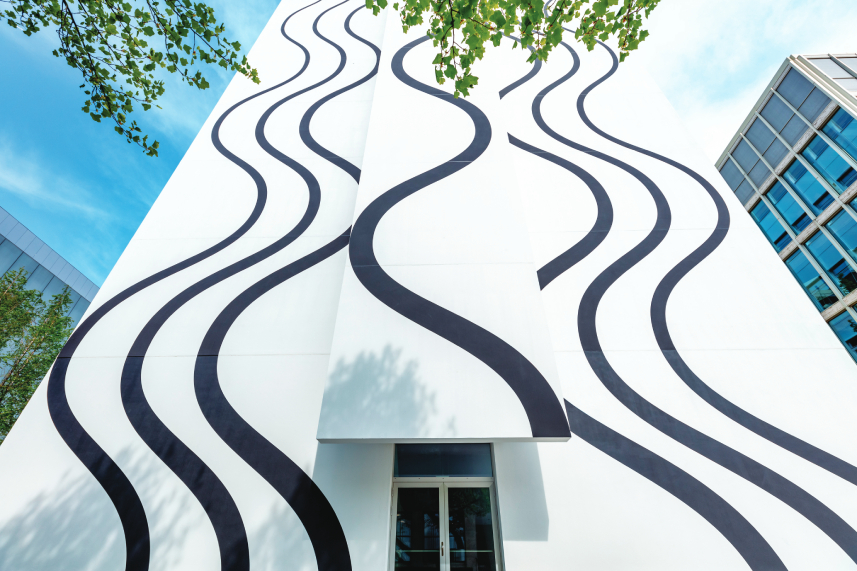
Banting 1, a research building on the Novartis Campus in Basel, features “Structure of Life,” a 60-meter mural by Swiss artist Claudia Comte inspired by the helical structure of DNA.
One such company is Cimeio Therapeutics, founded on academic research led by Lukas Jeker, M.D., Ph.D., professor in the department of biomedicine at the University of Basel and head of experimental transplantation immunology and nephrology at Basel University Hospital.
With early support from BaseLaunch, Cimeio officially launched in 2022, securing a $50 million Series A led by Versant Ventures. In late 2024, the company entered a research partnership with Kyowa Kirin valued at up to $300 million.
Cimeio aims to address the limitations of existing treatments for hematologic disorders, particularly the harsh side effects of conditioning chemotherapy, which restrict the broader use of cell therapies. The company’s Shielded-Cell & Immunotherapy Pairs™ combine proprietary CD45 antibody-drug conjugates (ADCs) with gene-editing shielded hematopoietic stem cells (HSCs). By introducing small genetic changes, donor stem cells become invisible to the ADCs, thus enabling the ADCs target and deplete diseased cells, while the cell-shielding technology protects healthy cells.
“In a process that takes about three to four days, we can engineer small mutations onto the surface of cells to make them resistant to damage caused by chemotherapy,” says Jeker.
The approach could be paradigm-shifting for the treatment of hematologic diseases and may also have implications in other therapeutic areas, including autoimmune disorders.
Cimeio is targeting entry of its lead program into the clinic in the second half of 2027. “The science works beautifully but investment is always challenging,” Jeker says.
Like many in the CGT field, he remains cautiously optimistic. “The whole industry is feeling the trickle-down effects of what’s happening in the U.S.,” he notes, pointing to declining NIH grants funding and increasingly risk-averse investors. “But CGT science is impressive, so I believe the funding will come back.”
From startup to international recognition
One of BaseLaunch’s most well-known alumni is T3 Pharma, a 2015 spinout from the Biozentrum at University of Basel. The company was among the earliest participants in the BaseLaunch accelerator and remains a tenant at Switzerland Innovation Park Basel Area.
In 2023, T3 Pharma was acquired by Boehringer Ingelheim for approximately $507 million. Boehringer had previously co-led a $27 million financing round in 2020 to support T3’s transition into clinical development. The pharmaceutical company plans to use T3’s technology to strengthen its immune-modulatory cancer pipeline.
T3 has developed a proprietary platform that genetically engineers Yersinia enterocolitica bacteria to deliver protein payloads directly into cells. These engineered bacteria function as precise delivery vehicles, injecting target cells with bioactive proteins, while sparing healthy tissue.
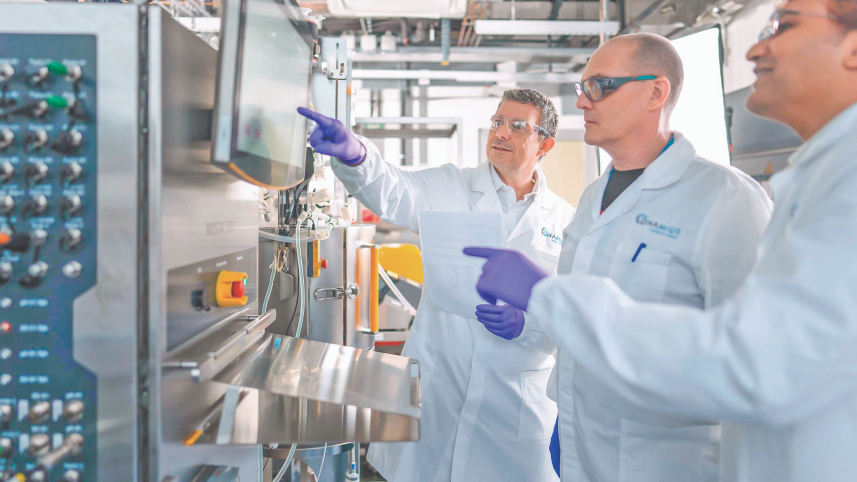
DINAMIQS’ cGMP manufacturing facility for viral vectors is the first of its kind in Switzerland.
Treating solid tumors has remained challenging — even for advanced modalities like CAR-T — due to the hostile tumor microenvironment. T3’s platform offers a promising approach to selectively activating immune responses within tumors. It’s lead candidate, T3P-Y058-739, is currently being evaluated in a phase 1 trial in patients with advanced solid tumors. The relative ease of genetically engineering bacteria also makes the platform highly adaptable, with potential applications beyond oncology.
The T3 story — an academic spinout that reached clinical scale and attracted a multinational acquirer — underscores the strength of the Swiss pharma ecosystem.
Beyond Basel
Swiss innovation extends well beyond Basel’s borders. Zurich, Switzerland’s largest city, is best known as global financial and banking hub, but it has also developed a thriving pharmaceutical and biotechnology ecosystem.
Zurich’s life sciences cluster evolved in the reverse of Basel’s. Rather than large pharma companies paving the way and later giving rise to startups, Zurich’s ecosystem began with university researchers spinning out new ventures. Over time, these successes attracted more established pharmaceutical players. Roche, for example, now operates its Roche Innovation Center Zurich within the Bio-Technopark Schlieren. As part of Roche’s pRED initiative, the center focuses on oncology product development.
Often considered the flagship of the Zurich biotech industry, Bio-Technopark Schlieren is an internationally recognized research location. Founded in 2003 as a privately developed site, the park today hosts around 60 organizations and 80 academic research groups, offering laboratory, production, and office space. University spin-offs, pharma subsidiaries, academic researchers, and clinical groups have all established a presence on campus.
Bio-Technopark is home to DINAMIQS, a CDMO specializing in adeno-associated virus (AAV) and lentiviral vectors and operator of Switzerland’s first cGMP viral vector manufacturing facility. DINAMIQS was spun out of Swiss biotech company builder DINAQOR in 2022 and acquired a year later by Swiss CDMO Siegfried. The acquisition marked the 150+ year old company’s foray into cell and gene therapy. Following the acquisition, Siegfried expanded DINAMIQS’ footprint to include a 3,000-square-foot state-of-the-art R&D facility dedicated to process development, analytical testing and manufacturing up to 50-liter scale. To support commercialization, Siegfried subsequently built a cGMP manufacturing facility on the same site.
Opened in fall of 2025, the new facility enables end-to-end viral vector manufacturing — from molecule design through aseptic product filling — under one roof, with production capacity scaling to 1,000-liters.
Despite continued clinical progress, viral vector manufacturing remains a persistent bottleneck in cell and gene therapy. Producing high-quality vectors safely, reproducibly, and affordably at commercial scale remains challenging.
“Our facilities were designed so that our customers can get everything they need from one partner and one location. This saves customers time and money when bringing therapies to patients,” says Martin Kessler, Ph.D., CEO of DINAMIQS.
CGTs face roughly twice the number of safety concerns and four times as many CMC challenges as monoclonal antibodies. To address this, DINAMIQS’ facility was designed with containment as a priority, using a modular, segregated layout that includes three fully separated suites — for seed train, upstream, and downstream processing — each supported by dedicated air handling units.
As viral vector complexity increases, CDMOs can no longer focus solely on manufacturing execution; biology now drives the process.
“As a CDMO partner, we really to need to deeply understand the biology to help CGTs be successful,” says Kessler. DINAMIQS’ leadership team reflects this approach, combining top scientists, including those with internal molecular biology expertise, with seasoned GMP experts.
Analytical challenges are another intrinsic part of viral vector manufacturing and DINAMIQS believes in getting out ahead of them. “Building an analytical strategy into your process development as early as possible is important,” says Eduard Ayuso, Ph.D. CTO of DINAMIQS. “You need to know what to measure, where to measure it and how.”
While early optimization can front-load costs, Ayuso argues it pays off over time. “I’ve had to explain this to investors as well,” he says. “Going faster doesn’t help if down the line you need to spend more.”
This combination of scientific depth, manufacturing rigor, and long-term thinking reflects the broader strengths of Switzerland’s innovation ecosystem — where precision, quality, and durability remain defining advantages in advanced therapies.
Claiming new ground
Switzerland’s transformation from a patent-agnostic state to a global life sciences leader was neither accidental nor inevitable. It reflects decades of intentional choices: investing in education and infrastructure, aligning academia with industry, protecting intellectual property, and fostering dense networks where talent, capital, and ideas can circulate freely.
Crucially, the country has cultivated a culture that values rigor over speed, collaboration over isolation, and durability over short-term gain.
That culture now provides fertile ground for the most complex and ambitious medicines in development. To succeed commercially, cell and gene therapies demand not only scientific excellence, but also manufacturing scalability and efficiency. By designing an ecosystem that rewards long-term thinking and precision execution, Switzerland has positioned itself not just to participate in the next wave of medicine, but to help steer it.
Subscribe to our e-Newsletters
Stay up to date with news, articles and insights relevant to cell and gene therapy development and manufacturing. Plus, get special offers from Cell & Gene Therapy Review delivered right to your inbox!
Sign up now!