Gene therapies, particularly those utilizing viral vectors, are prone to manufacturing bottlenecks and complexities.
To sidestep these historic hurdles, Ferring Pharmaceuticals has gone to great lengths to build robust infrastructure for Adstiladrin, its flagship gene therapy. Approved by the U.S. FDA in December 2022, Adstiladrin is an intravesical, non-replicating adenoviral vector-based gene therapy indicated for adult patients with high-risk Bacillus Calmette-Guérin (BCG)-unresponsive non-muscle-invasive bladder cancer (NMIBC) with carcinoma in situ (CIS) with or without papillary tumors.
The road to approval was not without obstacles. In 2020, the FDA issued a complete response letter (CRL) requesting clarification around chemistry, manufacturing and controls (CMC) issues. Ferring, through its Blackstone-backed FerGene subsidiary, was granted an extension to address the agency’s concerns before ultimately resubmitting its biologics license application in June 2022.
Ferring, which restructured its collaboration with Blackstone and gained full control of Adstiladrin and FerGene prior to the therapy’s approval, has spared little expense in its efforts to get Adstiladrin to patients, including nearly $500 million in manufacturing investments. With help from a royalty-based financing agreement inked with Royalty Pharma in 2023, Ferring has launched a three-pronged manufacturing strategy focused on increasing capacity, diversifying its manufacturing footprint and lowering cost of goods.
“The manufacturing strategy is to manage three things. One is capacity, because we expect a lot of global demand for the product; second is risk balance by diversifying our manufacturing footprint. Ferring is a large manufacturer and anytime a product is expected to be big, we want dual sources; third, we want to address costs, which for gene therapies, can be very high,” said Bipin Dalmia, senior vice president, global head, uro-oncology franchise at Ferring, during a recent tour of Ferring’s New Jersey facility.
With bladder cancer ranking globally as the third most common cancer among men — and a projected 2.2% increase in overall cases by 2025 — Ferring’s manufacturing foresight and investments align with both current needs and long-term ambitions for Adstiladrin, including new indications and global expansion.
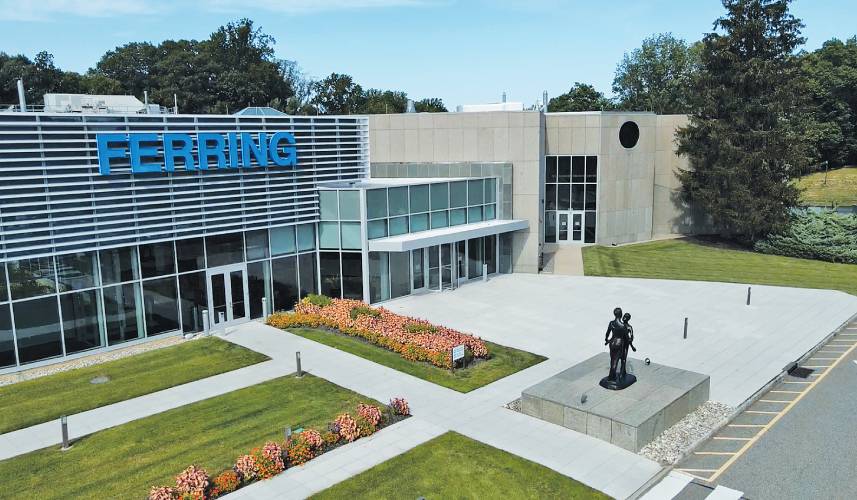
Among the company’s in-house manufacturing investments is a state-of-the-art 270,000-square-foot viral vector-based drug substance manufacturing plant in Kuopio, Finland opened last October with Ferring sister company, FinVector. Most recently, Ferring unveiled the next crucial piece of the Adstiladrin supply chain puzzle — an FDA-approved, highly automated drug product manufacturing hub in Parsippany, New Jersey.
According to Sean Goudy, Ph.D., PE, vice president and Parsippany site leader and general manager, the facility represents Ferring’s most advanced to-date, utilizing an updated manufacturing process.
“This facility represents the next generation of manufacturing for Ferring — built to support the reliable, large-scale production of Adstiladrin. By integrating learnings from our Finland site, we’ve developed a process that improves efficiency and yield, and strengthens our ability to consistently deliver this high quality therapy to patients who need it.”
An inside look at the NJ plant
Ferring broke ground on its new U.S. manufacturing facility in 2022, on the site of its former U.S. Operations Center in Parsippany, New Jersey. This past April, the company announced that the FDA had approved the new 12,000-square-foot facility for production.
Within the spotless, white-walled corridors of the plant, Ferring strikes a careful balance between quality and speed — a necessity when working with sensitive cell and gene therapy products.
The bulk drug substance for Adstiladrin — a recombinant adenovirus serotype 5 vector carrying the gene for human interferon alfa-2b — is shipped frozen at below -60°C from the Finland site to the New Jersey site. Once thawed for the fill-finish process, the product must be refrozen within 36 hours, making timing and precision critical.
To maintain sterility and efficiency, the facility uses sterile, single-use components. These ready-to-use systems enhance contamination control and eliminate the need for the labor-intensive cleaning and sterilization processes associated with reusable equipment.
A critical part of the operation is the plant’s advanced filling system: a fully automated Cytiva VAnRx robotic isolator. This gloveless, isolator-based technology performs a range of programmable robotic tasks, including isolator leak testing, vapor phase hydrogen peroxide (VPHP) sterilization of container closures, aseptic filling via a single-use flow path, capping and batch delivery. Ferring’s product has a maximum batch size of about 1,200 vials. All of this takes place without human intervention — minimizing the risk of contamination, protecting both workers and product, and ensuring consistent quality.
The isolator system also integrates in-process controls, such as robotic microbial sampling and real-time particle monitoring. With simplified setup and streamlined operation, the system reduces complexity on the floor — critical for Ferring, which has invested in training staff specifically to operate this sophisticated technology.
Built with expansion in mind
Ferring anticipates that demand for Adstiladrin, which registered approximately $79 million in its first full year of sales, will continue to grow exponentially. Ensuring patient access remains the top priority.
“Adstiladrin has transformed the treatment landscape for BCG-unresponsive bladder cancer patients. Ferring is committed to making Adstiladrin globally available to every bladder cancer patient who needs it,” said Dalmia.
So far, the company’s manufacturing investments have paid off. Just thirteen months after Adstiladrin’s FDA approval, Ferring announced that it had achieved full product supply ahead of schedule. Today, the therapy has 99% coverage for commercial and government-insured patients — a historically difficult feat for gene therapies.
The drugmaker has already filed for approval in high-risk BCG-unresponsive NMIBC in Europe and Canada. Ferring recently announced positive interim phase 3 results in Japan, in which Adstiladrin showed a 75% complete response rate at three months in patients with high-risk BCG-unresponsive NMIBC with CIS, with or without papillary tumors.
In parallel to geographic expansion, Ferring is also eyeing indication expansions. Adstiladrin is being evaluated in intermediate risk NMIBC, which currently has no FDA-approved treatments, in the phase 3b ABLE-32 trial. Adstiladrin is also being investigated in the phase 1/2 LUNAR study for low-grade upper tract urothelial carcinoma, a rare type of cancer found in the renal pelvis and the ureter.
By aligning its geographic expansion and clinical investments with its manufacturing strategies, Ferring is ensuring its supply scales with demand — better positioning the company to reach its goal of making bladder cancer a more manageable condition.
References
FerGene Provides Update on BLA for Nadofaragene Firadenovec. (2020, May). FerGene. [Press release]
Bonanos, P. (2021, April). Downsized FerGene gains FDA extension to resubmit gene therapy, resolve CMC issues. Biocentury.
Bladder Cancer Cases Expected to Rise in 2025, ACS Reports. (2025, January). BCAN.
Ferring Announces Full Availability of ADSTILADRIN in the U.S. (2024, January). Ferring. [Press release]
Ferring Unveils New Data with ADSTILADRIN at 112th Annual Meeting of the Japanese Urological Association. (2025, April). Ferring. [Press release]
Key Statistics for Bladder Cancer. (2025, January). American Cancer Society.
Bladder Cancer Treatment. Johns Hopkins Medicine. [accessed July 2 2025]
Three-Year Follow-up Data in BCG-Unresponsive NMIBC Show Durable Response to Treatment with ADSTILADRIN in Two Patient Cohorts. (2024, April). Ferring. [Press release]
Final Five-Year Analysis of Phase 3 Data With ADSTILADRIN Shows Durable Bladder Preservation and Consistent Long-Term Safety. (2024, May). Ferring. [Press release]
Subscribe to our e-Newsletters
Stay up to date with news, articles and insights relevant to cell and gene therapy development and manufacturing. Plus, get special offers from Cell & Gene Therapy Review delivered right to your inbox!
Sign up now!